


















 |
 |
 |
|
|
INCIDENTS |
|
|
|
|
|
|
INCIDENTS |
 |
|||||||||||||
|
RAF
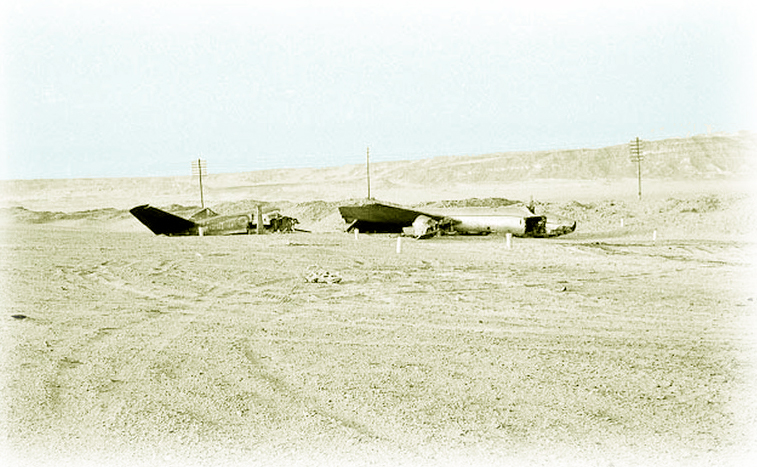
KASFAREET 1955 Click anywhere on the image below to read about this incident and view Alwyn York's excellent web site about a little known RAF Station in Egypt.
|
|||||||||||||
|
ROYAL AIR FORCE FIREFIGHTERS TACKLE 100FT BLAZE UNDER HEAVY GUNFIRE
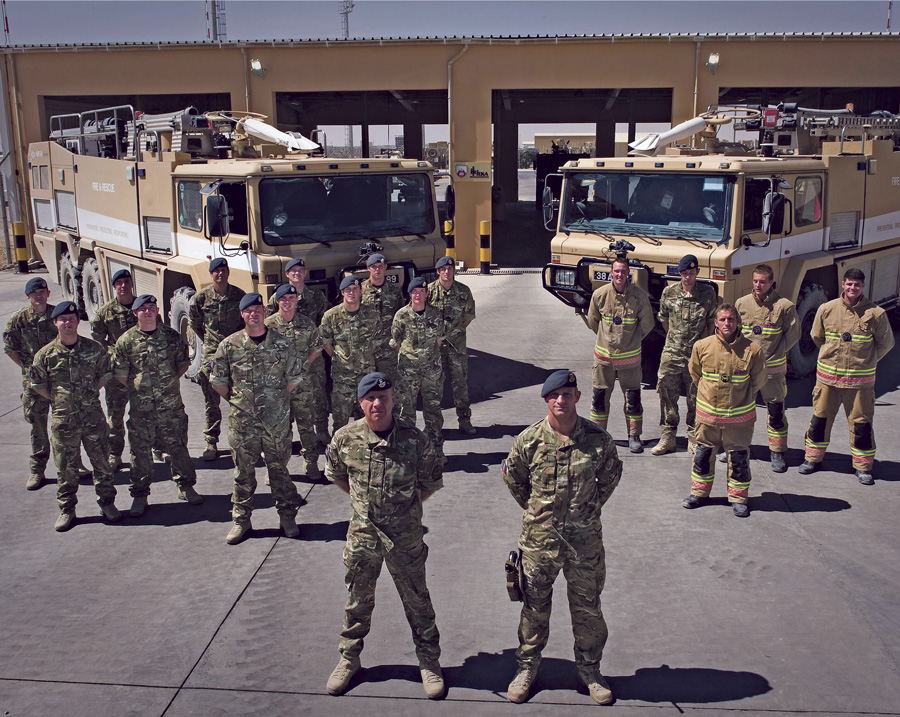
A brave team of Royal Air Force firefighters fought a 100ft blaze whilst under heavy insurgent gun fire on Friday night at Camp Bastion, Afghanistan. The fortified Camp came under attack by 15 heavily armed insurgents who had breached the perimeter fence. They were intent on causing maximum carnage and fired Rocket Propelled Grenades and AK-47 machine guns towards aircraft, buildings and coalition forces. The insurgents set fire to a bulk fuel storage facility, sending flames soaring over 100ft high. The Royal Air Force firefighters were ordered to approach the fire and start fighting the fire and search for casualties. The three fire crews cautiously approached the scene; at this early stage it was unclear exactly what had caused the blaze. As the crews approached the blaze they heard the distinct burst of machine gun fire. Convinced that the sound could have come from the blaze they continued forward. The crew soon realised that they could not get the engines close to the blaze because of multiple obstacles. They quickly rolled out the hoses and began dousing the flames. Within minutes the crews came under attack from the insurgents as rockets exploded close by. Sergeant Simon Allsopp was the crew commander responsible for controlling the chaotic scene. He said: "One of the crew shouted that he saw a rocket explode nearby and as I looked up I could see another one flying through the air. I yelled at my crew to stop fighting the fire and take whatever cover they could find". Sergeant Allsopp tried to radio for an update but came under heavy small arms fire. "As I tried to contact the HQ a burst of tracer was fired directly over our heads. For a moment it was quite surreal and then out of nowhere the Royal Air Force Regiment Force Protection assets arrived on the scene and immediately engaged the insurgents". As soon as he realised how close they were to the fire fight Sgt Allsopp gave orders to all his crew to withdraw from the very dangerous situation. As the crews were withdrawing Sgt Allsopp was stopped in his tracks by the cries of "MAN DOWN". A Royal Air Force Regiment Gunner was injured and the firefighters provided immediate first aid. Cpl Parry, one of the firefighters who treated the casualty, said: "we only had basic first aid equipment with us so we had to improvise and use whatever we could. I used the sling from my rifle as a tourniquet before we dragged the casualty to safety". Many of the crew had never tackled a blaze this big before and certainly never whilst under attack from Insurgents. Senior Aircraftsmen Jack Walsh, 21, the youngest member of the crew said: "I was quite excited but also apprehensive as we approached the blaze. I heard over the radio that there might be insurgents on the airfield. When we approached the blaze my training kicked in and all I thought about was putting out the fire. The Sergeant was great and used all his experience to control the situation." Corporal Rob Wallman-Durrant, in charge of ´Fire Crew Four`, said: "We were told to try and find another way to get closer to the blaze but we were blocked by a huge ditch on one side. Just as we were about to go round the other side, 2 RAF Regiment Force Protection vehicles went screaming past us. I didn’t know what they were doing here but was told to stop and join the other firefighters". The fire crews were ordered back to base until the insurgent threat had been dealt with. Warrant Officer Steve Hollis said: "The lads were absolutely fantastic and I am really proud of them. They showed courage, skill and robustness to tackle the blaze under extreme circumstances. Never in my 31 years have I been involved in tackling a blaze whilst coming under attack with small arms fire and rockets – full credit to the guys for continuing to do their job in such difficult circumstances". "The crews reacted quickly and performed outstanding fire fighting and military skills under extreme circumstances. The crews work long hours and do a difficult job in Afghanistan and in this incident demonstrated all the bravery, courage and determination required of an airman to undertake this task." The event culminated when Warrant Officer Steve Hollis and Sergeant Chris Dooley went out with Force Protection assets to assess the area. The area was confirmed as being clear of insurgents so Warrant Officer Hollis took control of 52 UK firefighters and their sheer number ensured the remaining flames were extinguished within 2 hours. Flight Lieutenant Kev Baker said: "The accumulative effort of all firefighters ensured that multiple pieces of mission critical equipment was saved from the blaze. The entire compliment of RAF firefighters at Camp Bastion were involved during this incident and everyone displayed courage and determination in the face of adversity". The incident is now under detailed review. Group Captain Jeff Portlock, Bastion Joint Operating Base Commander said "This was a serious attack on Bastion. The response of the firefighters and Force Protection personnel was highly professional, most effective and extremely courageous. Through their efforts, the spread of the fire was controlled, the insurgents were contained and the damage limited. He added "Bastion was quickly back to full operational capability and we continue to support ISAF operations on the ground throughout the region". The following has been kindly provided by RAF News:
Fire fighters who battled raging flames under a hail of gunfire during a Taliban attack on Camp Bastion have been honoured by the UK’s political leaders at a medals ceremony at Westminster. More than 50 members of the Air Force Fire and Rescue team were presented with their Operational Service Medals at the Houses of Parliament as recognition for their role protecting the ISAF base after a Taliban death squad breached the perimeter fence, in September last year. RAF teams fought for six hours to quell the fire storm that threatened to engulf the air traffic control tower and fuel storage areas as the RAF Gunners repelled the heavily-armed enemy fighters. Two US Marines and 14 insurgents died in the attack. SAC Dominic Garner said: “When the attack started we were a bit shocked and it took us a few moments to realise what was happening. “As we reached the scene I could hear the incoming small arms fire and I saw a rocket propelled grenade fly past smashing into the blast wall 30 metres to our left.” Force Fire Officer WO Stephen Hollis spoke of his pride in his men and the RAF Regt. He said: “The RAF Regiment were awesome that night. Without them we could not have got out there to do our job. “I am incredibly proud of the way the guys reacted as a team.” The fire fighters were also honoured by ISAF Forces at Bastion before returning to the UK. Speaking after they were presented with bravery awards last month, Camp Bastion Commander Gp Capt Jeff Portlock said: “All members of the RAF Fire Service acted swiftly on the night of this serious attack, displaying total bravery and professionalism.” The RAF team received their medals during a reception held by the All-Party Parliamentary Group for the Armed Forces at the invitation of MP Madeleine Moon. Introduced by Lord Lee of Trafford, and with Marshal of the Royal Air Force, The Lord Craig of Radley in attendance, the Servicemen were presented with their medals by the Deputy Serjeant-at-Arms, Gp Capt (Rtd) Mike Naworynsky OBE. There are currently more than 90 RAF Fire and Rescue Service personnel deployed around the World, including on Operation Herrick in Afghanistan. When not on operations, they provide a quick reactive resilience force that safeguards the Defence Estate and can be called upon to assist local authorities with serious incidents.
Fire Crew - Camp Bastion
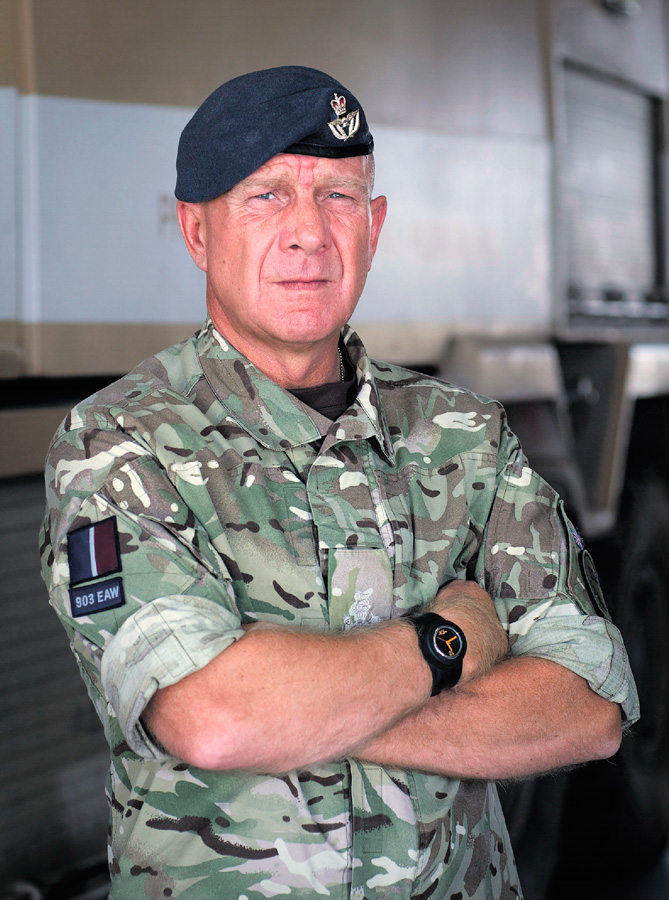
WO Steve Hollis
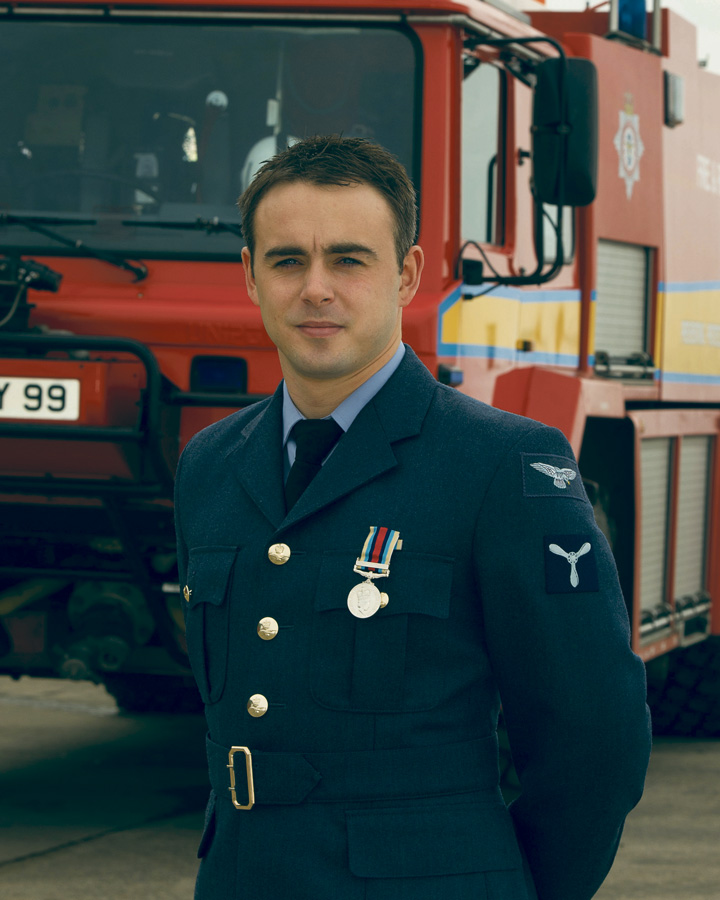
SAC Dominic Garner
|
|||||||||||||
|
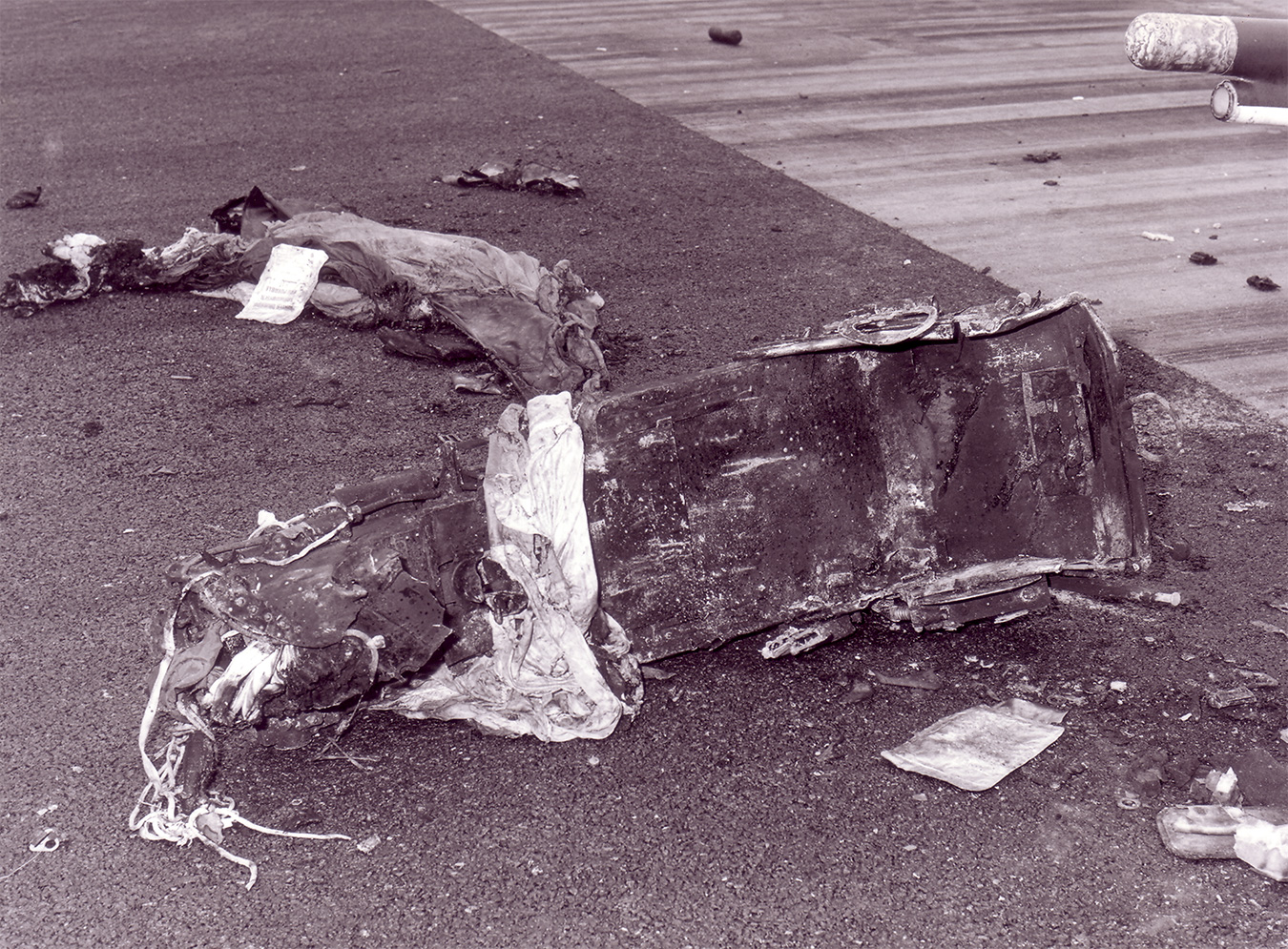
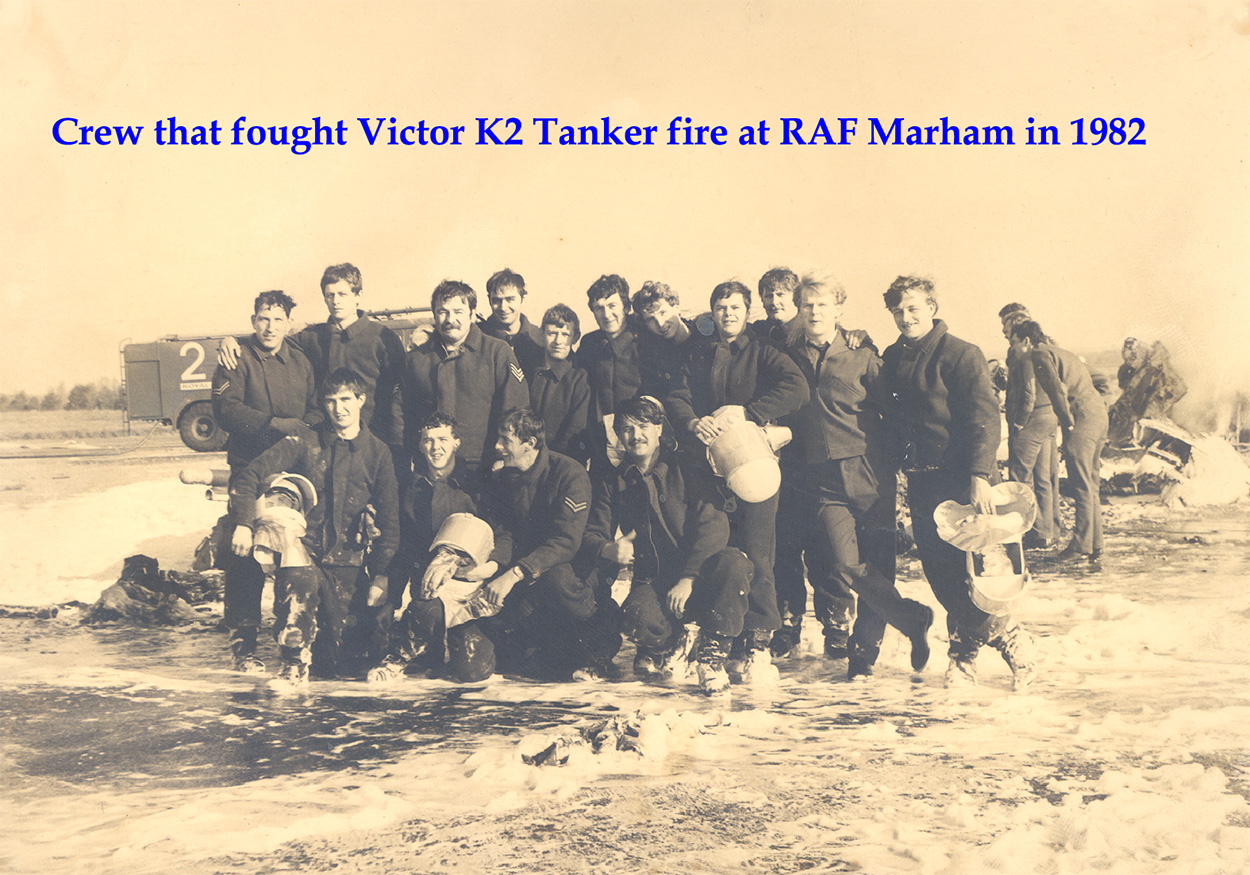
Victor K2 Fire - RAF Marham 1982 From Stew Bell At approximately 0850 on 15 October 1982 a fully fuelled Victor Tanker XL232 started its take-off run at Marham. As the massive airframe lumbered down the runway one of its four Rolls Royce Conway Turbojets suffered a catastrophic failure, causing shattered turbine blades to slice through fuel tanks. As the airframe gathered speed a rapidly growing fire developed. Take-off was quickly aborted and the Crash Crew mobilised within seconds. All five of the aircrew were seen to evacuate and a mass foam attack was initiated using two Mk 9s. The Crash 1 crew then managed to gain entry to the cockpit to try and shut-down the engines and fuel systems. Unfortunately the fire was too large to be extinguished completely during the initial stages and the crew were forced to replenish their water tanks using hard suction. Further delays were caused by a failure of one vehicle to prime, and ejection seats and cylinder started to explode in the intense fire. Local Authority Appliances arrived from Kings Lynn and Swaffham and the crews set up water relay to the crash site. However, the fire continued to re-ignite time after time again and the crews worked hard for over eight hours before the it was finally extinguished.
Photographs kindly sent by Stew Bell and Richard Czykita
Account of the incident as recalled by Richard Czykita:
Flashpoint account of incident
|
|||||||||||||
|
The Bug was here – An Arsonist Tale From Collin Hall As firemen at RAF Eastleigh, which was near Nairobi for the geographically challenged, most of our daily grind involved the airfield, and the domestic side was something we rarely thought too much about. Domestic fires were rare, very rare in fact, although we did have delivered a brand new Bedford Domestic. We’d previously used an old Bedford tanker with a trailer pump attached. Our Flt Sgt, an old ‘died in the wool’ type, promptly ruled the new vehicle must not turn out unless the trailer pump was attached! I think wiser and younger counsel eventually prevailed! Fires, as I say were rare, but then, completely out of the blue, we started get real turnouts to real fires, a whole series of them. There was one in the cinema, and in a parked ambulance outside Sick Quarters, and it became obvious that these fires were no accidents. Then the Camp Hobbies Club, which was mainly for vehicles people were working on, but was fairly well equipped with everything they needed, went up in a major conflagration. It was a long way past saving when we got there, so it was pretty obvious it had been helped along. There were gas cylinders cooking off, so we kept our distance! The camp was then on full alert, and we had extra men on shift, and extra security around the whole Camp, but we still managed to have yet another fire, this time in a kerosene store, our kerosene store, that is , where we stored the cans used to refill the Gooseneck flares. Now this was getting serious! We actually dealt with that fire very quickly, because not only were we getting better at this firefighting game, but it was quickly spotted. If any real heat had got to those four-gallon cans…it would have been Guy Fawkes night on a grand scale. So things were getting a bit tense around the place, although to be honest, I think we firemen weren’t all that unhappy at all the fire practice we were getting! Then we got a call to a barrack block our barrack block! The smoke had been spotted in the roof space and when we gained entry, and I was first up, the fire was out, but one severely burned culprit, who turned out to be one of us, a fireman, was still there! Had he succeeded with this particular fire, and he had a can of petrol, there would have been no escape for those of us in the roof space. So, we got him and his can out of there and into the open air, where he was promptly removed to Sick Quarters, under guard. So the crisis was over, and, believe it or not, we trooped off to the NAAFI for a few Tuskers, and of course our firemen mate was the sole topic of discussion. It turned out that when we all got our heads together, we realized he had been at all the fires, although he wasn’t always on duty at the time! Then, amazingly, we found a beer mat with “The Firebug was here” written on the back! The culprit was an SAC by the name of Roger Moore, and he subsequently was court-martialed and given five years, to be served in the UK somewhere. Before that happened, however, a team had come out from the UK which include one Warrant Officer John Arthur! Many years later, I met John at a reunion at Worthing, for the first time I thought, but the he told me: “we’ve actually met before”, and he told me he was on that investigation team. Small world sometimes!
|
|||||||||||||
|
|
|||||||||||||
|
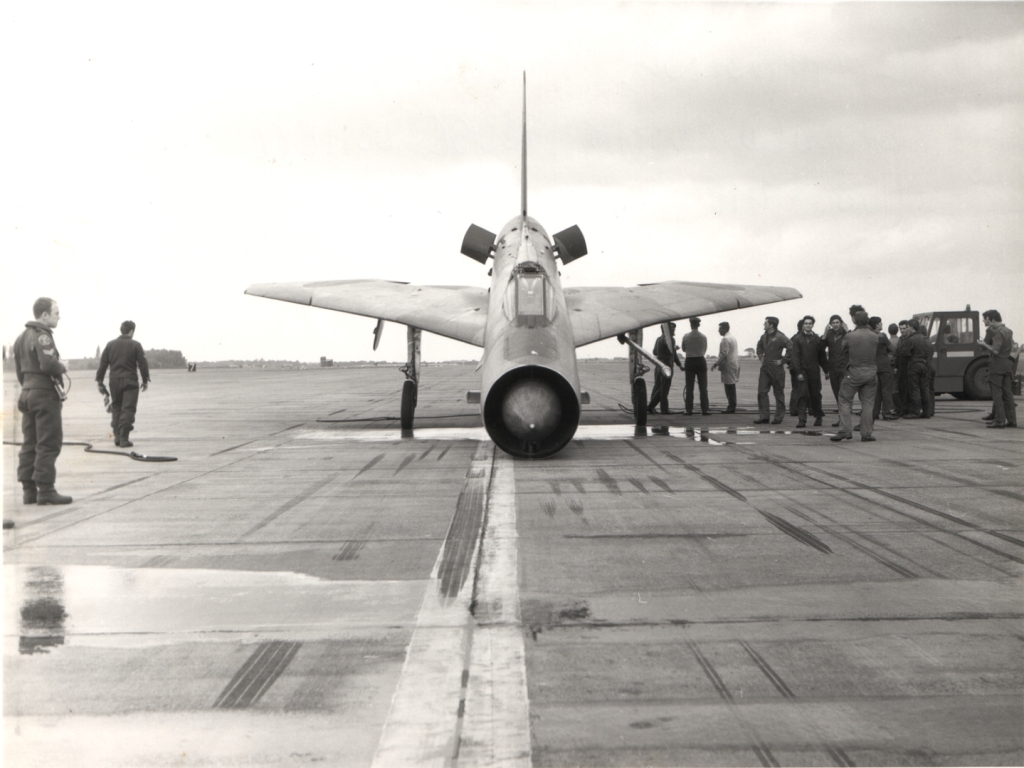
Lightning Nose-wheel-up Landing RAF Coningsby 1980
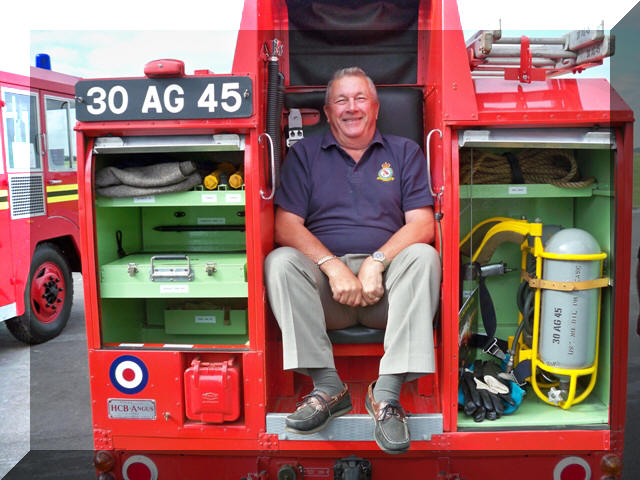
The above photograph was taken at RAF Coningsby on 14 September 1979. The Lightning was based at RAF Binbrook but on returning to its home base the pilot became aware that his nose wheel had failed to lower. Binbrook was at the time the duty Quick Reaction Alert (QRA) Station and it was deemed inappropriate to attempt a landing at Binbrook. The pilot was instructed to divert to Coningsby. The aircraft duly arrived in the Coningsby circuit and a State two emergency was called. Duty crash crew consisted of George Edwards i/c, Bob Wilding two i/c, John Cleminson Pete Thompson Ray Hunt Dell Fisher Geordie Martin Ivan Symcox Brian Peterson and a very young fireman by the name of Gordon Smith ( our Association Chairman ). Gordon had not long been out of training and his crew position on the day was rear seat passenger on Crash 1. I think it was his first response to a airfield emergency. Bob Wilding i/c Crash 1 duly briefed Gordon in his own inimitable style and informed him prior to deploying to the aircraft that the next time Crash One stopped he wanted the TACR hose line out in double double quick time. After several circuits the pilot positioned for his landing and the combine was instructed to follow the aircraft as soon as its rear wheels touched down. We deployed to our pre determined airfield emergency readiness positions and as soon as the Lightning rear wheels hit the runway we started to follow the aircraft. As we started our chase air traffic radioed that the combine was to stop and await further instructions . All the crew were aware of this new development except the unfortunate Gordon who was sat in splendid isolation in the rear alcove of Crash 1. As the combine vehicle came to a halt, as instructed Gordon aware of his last instruction from Bob Wilding immediately ran out the TACR hose line. No sooner had he completed his task when air traffic instructed the combine to resume its chase of the Lightning . Gordon was surprised to say the least when he had successfully completed his task only to be told by a very animated Bob Wilding to get the hose back on the vehicle or words to that effect. Gordon's new task was completed even faster and Crash 1 then led the combine in its chase after the Lightning. It was a remarkable sight as we followed the Lightning and watched the sparks fly as the aircraft's nose gradually lowered until it was soon scraping along the runway. When the aircraft came to rest the combine were ready in position to carry out any necessary and appropriate fire fighting action and Gordon had once more deployed the Crash 1 hose line in record time. As it was, the aircraft crash landed without catching fire thanks to an excellent piece of airmanship by the pilot (Squadron Leader Piper). Both the station Commander and Squadron Leader Piper thanked the crew for their support and one could see the sense of relief on Squadron Leader Pipers face as he was assisted out the aircraft by the Crash 1 crew . This could be considered a fairly routine incident but for Gordon Smith I am sure it was an incident that he will never forget. For those not familiar with the rear position on the TACR I have attached a photo of our Association Vice President Ron Brown sat in the position in a lot more relaxed conditions than those experienced by Gordon during our Lightning incident of 1980 However Ron during his time at RAF Gutersloh spent many an hour or two in what must have been the worst of all RAF Fire Vehicle positions.
From George Edwards BEM
Note from webmaster:
The Mk6 Lightning XS903 shown in this article was built at Salmesbury and made it's maiden flight on 17 August 1966. It survived a number of incidents during its RAF life before being retired from service and flown to Elvington on 18 May 1988. It can still be seen at the Yorkshire Air Museum where it is now displayed sporting a pair of recently fitted over-wing fuel tanks.
See http://www.yorkshireairmuseum.org/ for more info on the museum.
Dave
|
|||||||||||||
|
SS Daphne Fire
RAF Masirah 27 March 1968
The following is taken from documents sent by George Edwards Mem 238. |
|||||||||||||
|
OPERATIONS RECORD BOOK OF RAF MASIRAH FOR PERIOD MARCH 1968 COMPILING OFFICER Flt Lt A.E Howard
Dated 27 March 1968
Squadron Leader RJ Spears left the station on the 27 March after handing over to the new CO Squadron Leader R.F. Gratton. Half an hour after the departure of the Argosy the events aboard the Daphne began. The SS Daphne anchored off the coast of the Island preparatory to discharging cargo for Messrs Wimpey. The Master Paulos Ambietles radioed RAF Masirah requesting assistance in fighting a fire on board his ship. RAF Masirah responded by sending men and equipment which were taken by sea to Daphne by a detachment of the Royal Corps of Transport using Uniflotes. Operations were hampered by a rough sea and the men of Masirah and RCT displayed resource and courage in a dangerous and difficult situation. The fire was located in No 4 Hold and between the decks area and although hampered by bulky deck and hold cargo the fire was extinguished at 14.30 on Friday the 29 March. During operations, the No 4 Hold had to be flooded and the Master requested assistance in pumping out. Pumping out now complicated by a mass of loose floating cargo continued until the Hold was clear at 06.00 on the 31 March. The ship weighed anchor at 10.15 on the 31 March and sailed for Daman. It is very doubtful whether the ships crew using their own inadequate equipment could have prevented the Daphne from becoming at least severely damaged and probably a total loss.
|
|||||||||||||
|
George's first hand account as told in his book "Out of the Blue"
Daphne Incident RAF Masirah March 1968 In terms of actual incidents, Masirah had very few during my twelve month tour. I remember when there was a squadron of Hunters transiting though, one took the barrier and we were left to extricate the aircraft. Having said that, Masirah did produce one of the all-time classic incidents in the annals of the RAF fire service. Near the very end of my tour, come to think of it I was tour-ex King (the one who was the next to return home), I was instructed by Flight Sergeant Ditchfield to standby with the trailer pump, and we were going out to a ship on fire. My colleagues, Jock McVey and Ian Easter, and I prepared ourselves for the expected brief sojourn to put out this small fire on board a passing merchant vessel. The Flight Sergeant met us at the jetty and we were ferried out by Rhino, a large platform used by the RCT to unload ships. The journey out was uneventful and quite pleasant. The Flight Sergeant had by now exerted his authority and was, in fact, well respected. I was only days away from going home and was reflecting on an otherwise happy tour of duty. We were all led to believe that we were going out to a small fire on board the MV Daphne a Greek registered merchant vessel. On arrival it was not quite like that. Initially Jock and I lashed the trailer pump to the Rhino while Ian set up the delivery end and waited for instructions from the Flight. It was obvious from the Flight Sergeant’s expression that this was not a small incident. "This ship is carrying a dangerous cargo and the fire could well reach it anytime. Get to work." In times like that training overcomes fear and, almost instinctively, Jock and I set about getting water up to Ian. Flight Sergeant, meanwhile, contacted Masirah and reinforcements in terms of fireman and other station personnel were brought out. Large quantities of foam would need to be pumped into the ship hold, a further indication that this was a serious incident. By the time the reinforcements arrived, Jock and I had found our sea legs and became accustomed to the motions of the ship. Watching the arrival of the additional personnel, many of whom were not firemen and therefore not possessed with those natural fireman qualities of tenacity and robustness, was quite sad. There really was fear written over many faces and, on reflection, it was quite a difficult and dangerous activity, throwing yourself on to the rope ladder dangling from the side of the Daphne. You had to judge the swell of the sea, go at a wave Zenith and make a dash for it; one slip or slight delay and you were crushed by the returning Rhino. There were some that were simply too frightened to take that plunge and they remained on the support vessel. An additional fear factor was the omnipresent sharks. My mate Phil Sinnot was one of those to travel out with the support group. I watched from the Rhino as Phil climbed the rope ladder. He was just about to climb aboard the Daphne when I heard the Flight Sergeant say, "You’re not joking now Phil". Phil replied, "What did one VD germ said to the other; if I fall now I’ll be a right gonorrhoea." The support team got to work hauling compound drums onto the Daphne. Now picture the scene - drums of foam compound being hauled up the side of the Daphne, many drums bursting, disgorging their black pungent, smelling contents into the ocean. Foam compound in those days had ox blood as a constituent part - great manure for the garden but even greater for attracting sharks. Before long, large numbers of sharks were on patrol looking for a tasty fireman. Sounds a bit like a NAAFI dance but these sharks removed the parts that a NAAFI shark would normally caress. Once onboard the Daphne, personnel were put to work assisting in the movement of hose. Jock and I continued with our task. We remained on the Rhino looking after the trailer pump and the suction hose. The sea was becoming quite choppy and there was a possibility we could be washed overboard. Consequently, Jock and I secured ourselves to the Rhino by rope borrowed from the ship crew. As the evening drew in, the additional personnel were taken off and returned to Masirah their task completed. Jock and I remained all night on the Rhino, occasionally receiving small scraps of food from the ship crew. Our task basically was to keep the trailer pump full of fuel and to ensure the suction hose remained in the sea. In addition we were constantly adjusting our rope lashing and those of the trailer pump. During the night we received a message from Flight Sergeant Ditchfield that the ship’s captain was concerned that the Rhino might damage the side of his ship. We were attached to the Daphne by rope and, depending on the swell of the sea, we did occasionally bang into the side of the Daphne. It wasn’t a pleasant sound especially as we were not rising and falling in tandem with the Daphne. We would more or less hit the Daphne then bounce up and down its side. "We’re going to have to move you away from the side of the ship" and, although separated only by about fifty feet, abandoned almost on a flat bottomed steel platform in shark infested waters, at night and in increasingly heavy swell is something that doesn’t fade from the memory. We continued pumping throughout the night until we received a message that the fire was now out. We were to remain on the Rhino till dawn and then take it from there. Come daylight we were, I remember, very hungry and very tired but we were a team well trained and well led so that compensates for those discomforts. The Flight Sergeant informed us that the danger of fire and explosion had passed but there was a new danger the ship’s hold was full of water and there was a possibility the Daphne may list and sink. Jock and I now had to move the trailer pump on to the Daphne and start pumping out the hold. This was a relatively straightforward task but once the suction hose was lowered into the hold it regularly became blocked. All sorts of debris were swirling about and I had been tasked to look after the suction hose, so it went without question that I would be lowered into the bowels of the Daphne and off I duly went. I spent three days and two nights on the Daphne, no sleep, little food but content in the knowledge that I had put into practice many of the skills and knowledge gleaned from my training. I also had great faith in the Flight Sergeant. The situation stabilised and the Flight Sergeant, aware that I was shortly to return home, made arrangements to get me ashore. I remember arriving back at Masirah and, would you believe it, the Station Commander who had only been in post a few days was there to meet me in his car and conveyed me to the airman’s mess where a meal awaited me. The Station Commander had probably previously never spent more than a few minutes in the company of an RAF fireman but here he was sat next to one who had not washed or slept for three days, who was very tired and probably talking gibberish. He probably still thinks RAF firemen are always like that. The MV Daphne incident is included in the annuls of the RAF fire service folklore. Flight Sergeant Ditchfield was awarded The British Empire Medal, voted Man of the Year and was featured in the 1968 television documentary featuring the Royal Family. Her Majesty was heard to comment on the Daphne incident and mentioned Fight Sergeant Ditchfield specifically. Two years after the incident I was now stationed at RAF Church Fenton when I received an extra £19 in my weekly pay - that was a huge bonus in those days. I duly went to general office and was informed that this was my part in the salvage money relating to the MV Daphne. I became a bit of a celebrity for a while at Church Fenton, especially after embellishing the story a tiny bit to the women in general office. Some five years later, now stationed at RAF Brize Norton, I met up with Gordon Dichfield. He was now a Flight Lieutenant and I was a Corporal. I was to realise that Mr Ditchield was one of life’s gentlemen and not the fearsome task master that we all thought he was. Sadly Gordon and big Jock Mc Vey have moved on to that big fire section in the sky but their memory lives on. The Daphne incident took place forty years ago and for the vast majority of that time I have thought very little about the Incident. I have been stationed with my good friend Steve Harrison twice since the incident but during that time I don’t think we ever mentioned the Daphne once. When we were stationed at RAF Stanley we had in fact no time to talk about anything other than our current situation. We were the two fire Crew chiefs at Stanley and the only time we met was at shift change. We had quite an important task to complete during shift change and that was the handing over of the armoury key. Not quite the same as the spectacle of the Keys ceremony at the Tower of London but nevertheless a very important operation. Steve and I were also together at Llaarbruch as young Corporals and with very young children the Daphne incident was far from our thoughts. However with the passing of time and learning of the death of Gordon Ditchfield and Big Jock Mc Vey I thought it important to try and record this little piece of RAF Fire Service history. I contacted The RAF Museum at Hendon who very kindly provided a copy of Gordon Ditchfields London gazette report. I also employed a researcher for a very small fee) and he obtained a copy of the Masirah Operational Record Book which he obtained from the National Archives at Kew. I do hope you enjoy reading about the Daphne incident and I hope it will encourage others to record any incidents that they may have experienced and pass them on to our webmaster Dave Kirk who is doing an excellent job The following RAF Firemen took part in the Daphne Incident Flight Sergeant Gordon Ditchfield (the boss) Sgt Pepper Sgt Farrell Andy Anderson Ian Easter George Edwards Steve Harrison Ian Judge Kevin Meeson Paul McGhee Phil Sinnot Jock McVey
|
|||||||||||||
|
Steve Harrison's account of the event: My recollections of the incident are as follows:
I was on the off duty crew as the shift pattern was 24hrs on 24 off. I recall being in my room or around the billet area when we was told to report for duty as some of the duty crew had been dispatched to a ship fire and we had to cover for them on the Crash crew in order to keep the manning requirements and release some of the duty crew to the incident. Masirah was only a staging post and incidents were few and far between so all the lads left on the section were very keen to get to the action, for myself it wasn’t to be for a couple of days. In the meantime we were kept busy organising kit that was requested from the scene also I remember us having to load 5 gallon drums of foam compound by hand on to a trailer, and in the mid-day heat it was hard work and smelly if a drum split, still in those days I was young and fit. We received the news; I think it was on the second day that the fire had been extinguished by the lad’s which was good work, as RAF Firemen never received any training on ship fires. The lads were lead by Flight Sergeant Gordon Ditchfield also on board was Ian Easter Jock McVey and George Edwards I cannot remember who else. Some of us were told that we were going on to the ship to assist and relieve some of the lads so I was excited at the prospect. When we arrived at the jetty we were told that we would be going to the ship via a tug which had arrived and belonged to some Oman company. So we embarked on to the tug, the sea swell was very large and a bit scary but exciting. As we came to the ship you knew it was going to be tricky to say the least getting on board the Daphne. A Royal Corp of Transport (R.C.T) Rhino platform was at the side of the ship on which trailer pumps were lashed down and fireman manning them holding on for shear life. With the swell you could see the platform rise from about 20ft down the side of the ship then nearly up to the deck. The captain of the Oman tug thought it to dangerous and we had to return. We were then transported out on another smaller vessel and finally had a thrilling transfer to the rhino platform. I talked to the lads on the rhino manning the trailer pumps one was George Edwards as I recall, then we had to get aboard the Daphne. This was no easy task as the only access was via a rope ladder, the technique was wait till the rhino platform rose on the immense swell then calculate that it was at its peak then grab the rope ladder and I think the words-‘Geronimo and F……..Hell comes to mind. The sight of the platform disappearing below you and crashing in the side of the Daphne was not a comforting one. Still this was what I had joined the RAF for, excitement and adventure.
|
|||||||||||||
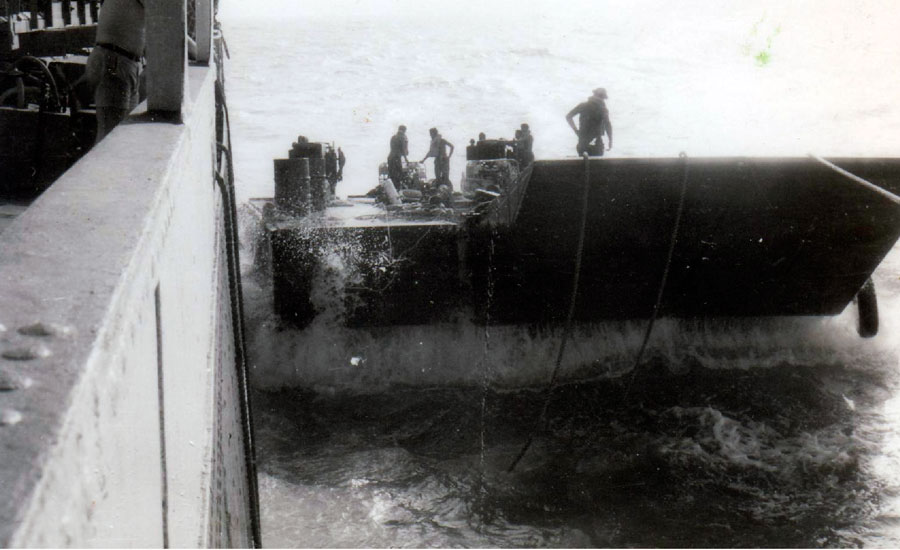 RAF Fire Fighters aboard the RCT Rhino Platform |
|||||||||||||
|
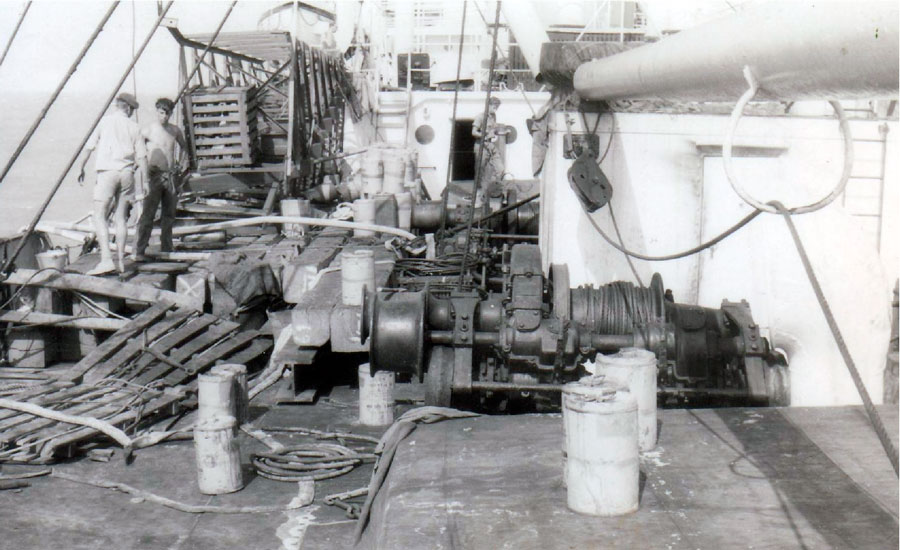
When we got aboard I remember the deck was a shambles with allsorts of pallets, empty foam drums bits of metal and of course hoses. There was still work to be done, the ship was listing quite a lot so the hold had to be pumped out, and also there was some concern that there were some hot spots or some problem down below that had to be investigated. I can remember (see photograph 2) that this task fell to Sgt John Farrell (I can’t remember who else) If I recall it wasn’t a fire service BA that was used but a ships one and could have been a remote one at that. As I recollect the others on the ship (apart from the lad’s on the platform) was Paul McGhee and Andy Andrews, but I cannot remember who else. It was hard day at the office and I returned to shore that evening. So my part was only a small one compared to the others involved but it is all about team work and support.
|
|||||||||||||
 (Left) myself (centre) Sgt John Farrell (right) ‘Smiler’ Meeson |
|||||||||||||
|
It’s nearly 40 years on and memories fade, but I do know that we had to return to shore, (if it was that day or another day I don’t remember) on the rhino platform (or another one) firstly because no one would risk the transfer again as the seas were still rough and also one of the trailer pumps had ‘blown up’ and needed to be repaired to continue with the pumping out of the hold. I cannot remember who was aboard with me but remember the journey back to the shore. The trailer pump was strapped down in the middle of the platform and there I was with a couple others hanging on to it as we rode the swell. I admired the Army guys who were in control of the massive engines at the rear of the platform, it was quite a feat to get us back, and again the thrill of it was immense. That is my recollections of that time and looking back it was a unique incident and it was good to be part of it. I did grace the shores of Masirah once again about 4 years later but no ship fires on that tour! I was only 20 years old at the time and during my 25 years service of all the lads involved I only came across George Edwards and Paul McGee again. Yet in April 2002 out of the blue I received an email from Gordon Ditchfield saying ‘I remember you’ I was amazed at the detail in which he remembered me and I was quite taken aback, he wanted to know about my career and family and it was a pleasure to exchange information about our lives after so many years. So we managed to ‘talk’ by email a few times before he sadly passed away. I always remember him being a tall guy who exuded authority but was a gentleman. I wish I could have met him one more time. It would also be good to meet again all those guys from that time.
|
|||||||||||||
|
|
|||||||||||||
|
With amusement I remember that a photograph of myself was published in The Hull Daily Mail relating to the incident. (Photo 4) and when I went on leave to the UK for my sisters wedding my friend told me that his girlfriend, who worked in a store had been looking at the paper and a few of the girls had mentioned that I was a ‘bit of alright’ When she said that she knew me I had a few offers of dates.
Gordon Ditchfield's citation: |
|||||||||||||
|
Supplement to the London Gazette, 22nd October 1968 (11327) Air Force Department Central Chancery of the Orders of Knighthood
St James’s Palace London S.W.1 22nd October 1968
The Queen has been graciously pleased to approve the award of the British Empire Medal for gallantry (Military Division) to the under mentioned L4101163 Flight Sergeant Gordon Frederick Ditchfield RAF Regiment.
On the 27 March 1968 the Master of the SS Daphne called upon RAF Masirah for assistance in fighting a serious fire which had broken out on board his ship. Sea conditions were difficult with a long running swell and the ship was moored some three miles off the coast. Shade temperatures averaged 87 degrees and in the sun at midday temperatures rose to 130 degrees. A party of three Royal Air Force Firemen was despatched to the SS Daphne .Upon arrival Flight Sergeant Ditchfield assumed control of the operations of his own party plus the crew members detailed for fire fighting. His difficulties were immense. He was working in an unfamiliar environment the ships motion made working conditions difficult particularly when carrying equipment along narrow corridors and down steep walkways. He was not trained in fighting ship fires and was completely unaware of the details of the ships fire fighting equipment the structural layout between decks and around the holds and the disposal of the nature and layout of the cargo carried. The fire was intense and gave off much thick smoke. The combination of the smoke plus the heat generated by the fire which was aggravated by the naturally hot fire climate of the Persian Gulf placed a severe strain on the physical endurance of the fire fighting party especially when working in confined spaces between decks, It was not always possible to relieve the RAF members of the fire fighting party by trained firemen and on several occasions Flight Sergeant Ditchfield had to work with members of the Station Emergency Guard who were not trained in the most elementary form of fire fighting. The ships crew were similarly extended and had to use all hands skilled or semi skilled to assist with the task. Flight Sergeant Ditchfield personally made four attempts to enter the main hold to locate the seat of the fire and he remained in charge of the operation for five days and nights until the fire was extinguished. He fully appreciated that these attempts were fraught with danger and that had an explosion occurred in the hold the consequences would have been catastrophic for him and ultimately the ship. No members of the ships crew would venture as far into the ships hold because of the high risk involved. Despite fatigue irregular meals and very little sleep Flight Sergeant Ditchield directed his limited resources with and his largely inexperienced fire fighting force with energy courage and determination. Throughout under exacting conditions he displayed outstanding devotion to duty. His calm and efficient leadership gave inspiration and personal example were major factors in countering this major emergency which might well have led to the loss of the ship His performance was in accord with the highest traditions of the Service
|
|||||||||||||
|
|
|
|
|
|
|||||||||
.jpg)

.jpg)
.jpg)
.jpg)